
Understanding Startup Funding
Not All Money Is The Same. How To Choose?

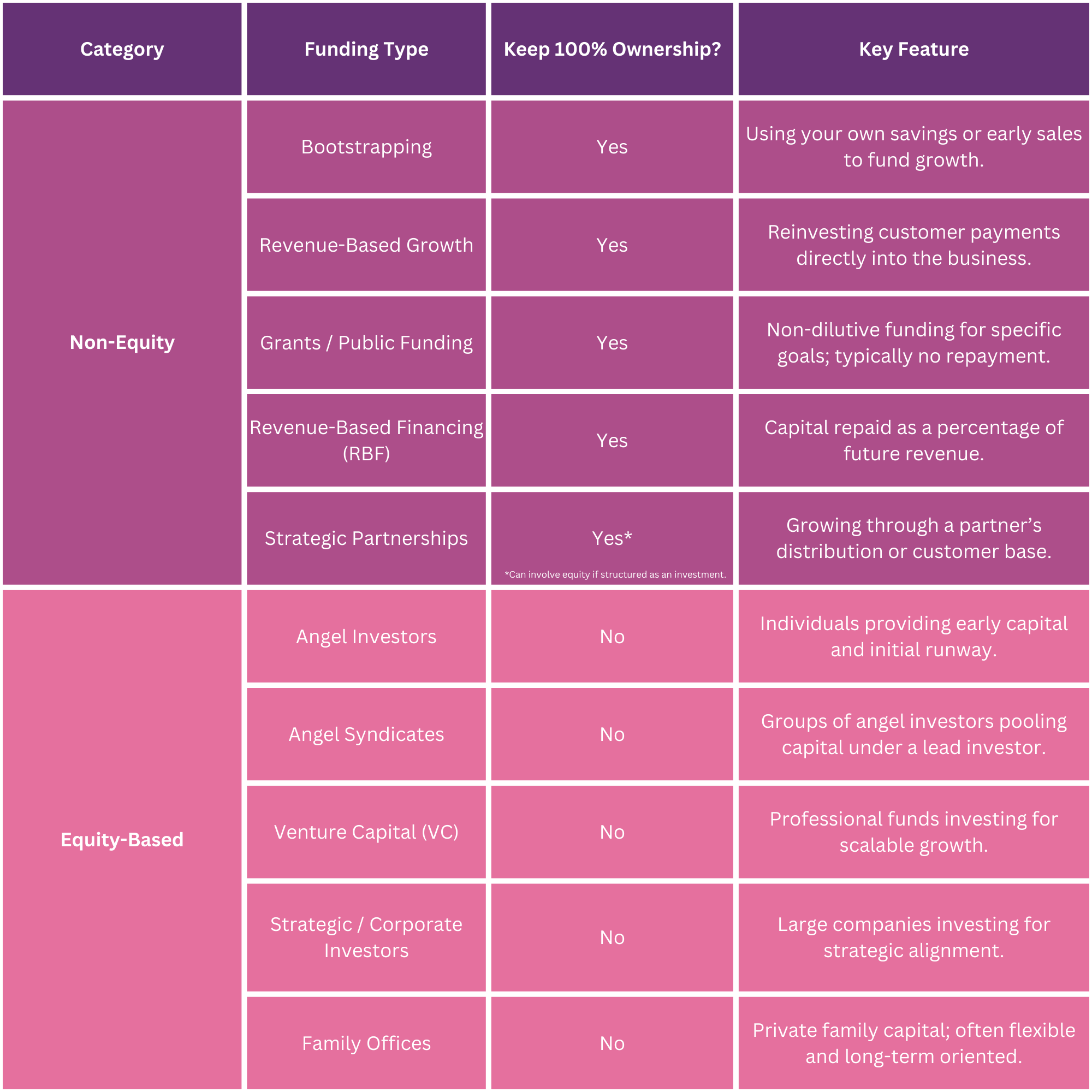
If you’re building a startup from zero, funding can sound like a private language. In reality, early-stage funding is easier to understand if you sort it into two buckets:
Money where you keep full ownership (you don’t give away equity).
Money where you give away a piece of the company (equity funding).

1) Non-Equity Funding (You Keep Ownership)
These options help you move forward without selling a piece of your company.
Bootstrapping
You build using your own resources: savings, side income, and early customer money. The goal is to prove the basics (real problem, real demand) while staying lean. Bootstrapping is commonly described as building with minimal outside capital.
Good when:
· you can start small and test quickly
· you can charge early or keep costs very low
· you want maximum control and flexibility
Revenue-based growth
This simply means customers pay you, and you reinvest that money back into the product and the team. It’s the cleanest path when you can get to paying customers early.
Good when:
· you can sell a paid pilot, contract, subscription, or service early
· you want growth that stays closely tied to real demand
Grants / public funding
Grants are money awarded by governments, foundations, charities, corporations, or similar donors. A key feature of grants is that they typically do not need to be repaid, but they are usually competitive and tied to specific goals or eligible activities.
Good when:
· your work fits a specific public goal (innovation, research, social impact, etc.)
· you can handle application and reporting requirements
Revenue-based financing (RBF)
RBF is a way to raise capital where you repay investors using an agreed percentage of your ongoing revenues. It is commonly presented as an alternative to giving away equity, and it generally works only once you have meaningful revenue.
Good when:
· you already have steady revenue and healthy gross margins
· you want capital without selling more equity
Strategic partnerships
Strategic partnerships (also called strategic alliances) are agreements where two or more independent companies cooperate to reach a business goal (for example: building together, co-selling, or distributing together). [6] For early startups, a good partnership can be a faster path to customers than paid marketing.
Good when:
· a partner already has the customers you’re trying to reach
· you can make the partnership simple and measurable (clear deliverables and timeline)
2) Equity Funding (You Exchange Ownership for Capital)
These options bring money in exchange for equity. Equity funding can increase speed, but it reduces ownership and can add external expectations.
Angel investors
Angel investors are early-stage investors who provide initial funding to startups, usually in exchange for ownership equity. A great angel investor can also bring introductions and practical support.
Good when:
· you need a first runway to build, test, and reach real users or customers
· you want a small number of supportive backers who can open doors
Angel syndicates
An angel syndicate is a group of investors who pool capital to invest together, often led by a lead investor. Platforms like AngelList describe syndicates as investing through a single vehicle so backers can participate in larger deals with smaller individual contributions.
Good when:
· you want to raise from angels but keep the process organized
· you have a strong lead investor who can attract other backers
Venture capital (VC)
Venture capital is funding from a professional investment fund that supports startups and early-stage companies with the potential for substantial, rapid growth, in exchange for an ownership stake.
Good when:
· your product can scale to a very large market
· you need speed (hiring, product build, expansion) and can handle growth pressure
Trade-offs to understand:
· you give away equity
· investors typically expect fast growth and clear milestones
Strategic / corporate investors
Some large companies invest directly into startups through corporate venture programs. Corporate venture capital is commonly defined as equity investments in privately held ventures by established firms, often motivated by strategic objectives as well as financial returns.
Good when:
· the investor can unlock distribution, partnerships, or industry access
· your goals and their strategic goals truly align
Watch out for:
· terms that restrict who you can work with next
· pressure to build only what benefits the corporate investor
Family offices
A family office is a private advisory firm that manages the financial (and often personal) affairs of a very wealthy family. Some family offices invest in startups, but they are not the same thing as a VC fund.
Good when:
· you want equity funding that may be more flexible or long-term oriented
· you find a family office whose style matches your pace and sector
How to Pick Funding Based on Your Startup Type
Below is the full breakdown by startup type:
Description
Best First Moves
Can Work Too
Be Careful With